Meme Coin Entry Strategy That Beats FOMO
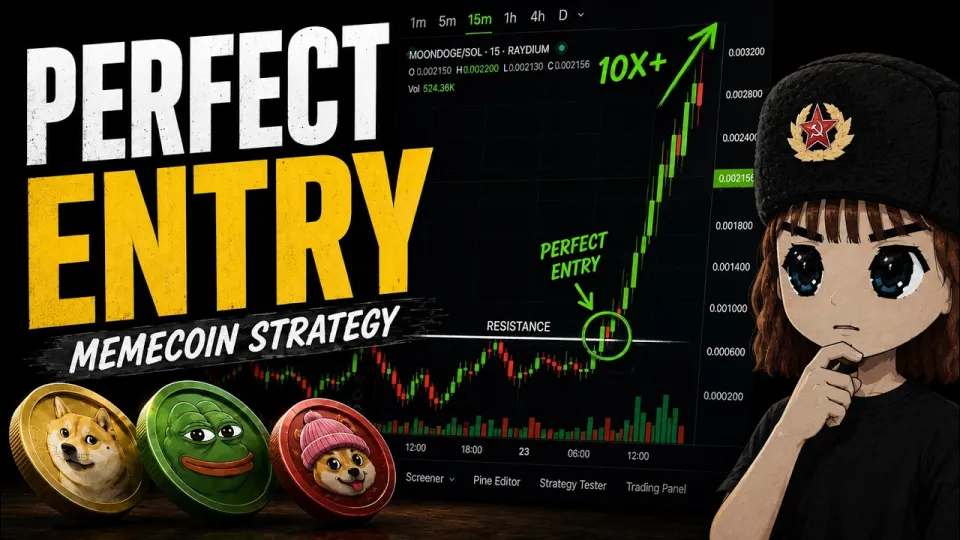
Video: How I Find the PERFECT Entry on Memecoins 📈 (Full Strategy)
Need articles like this for your video? They help promote it on YouTube and Google — order them in the Telegram bot @sat_sit_bot. Articles with your video embedded are written and posted by the bot itself — on popular topical sites (no ads). Free trial — 50 articles.
· based on the channel starwifpump
Key takeaways
- Most meme coin losses come from bad timing, not bad coin selection — entry price sets the entire risk-to-reward of a trade.
- A valid entry needs three confirmations: chart structure, momentum without a vertical blow-off, and a defined invalidation level.
- Pullbacks to support and prior breakout zones give better entries than chasing green candles after a vertical run.
- No entry if liquidity is thin, the chart is a straight vertical candle, or the move already extended without a base.
- Risk, exits and profit-taking are planned before the buy, not after the position goes green or red.
A meme coin is a highly volatile token with no cash flow or fundamental valuation, so the only edge a trader controls is timing: where you enter determines your risk-to-reward far more than which ticker you pick. In practice, a good meme coin entry means buying structure — support, a confirmed breakout or a controlled pullback — instead of chasing a green candle out of fear of missing out. The full breakdown of this process comes from the starwifpump video "How I Find the PERFECT Entry on Memecoins", and early access to the multi-tool terminal the channel promotes is available through the Plasma Telegram group.
Why entry timing decides meme coin outcomes
Most meme coin traders do not lose because they chose the wrong token; they lose because they bought at the wrong moment. A token that runs 300% and then retraces 60% punishes the buyer of the top far harder than the buyer of the base, even though both held the same asset. Entry price sets the distance to your invalidation level, and that distance is your risk. If you buy after a vertical candle, your stop has to sit far below, so position size shrinks and one normal wick takes you out. If you buy on a pullback into support, the stop sits just under the level and the same account risk buys a much larger position. That is the entire mechanical argument for patience: same coin, same thesis, completely different trade.
The three confirmations before any meme coin buy
A repeatable entry checklist beats intuition, because meme coin charts move fast enough to make improvisation expensive. The framework used in the video rests on three confirmations that should line up before a position is opened.
- Structure. The chart should show a base, an accumulation range or a clean higher-low sequence. A token with no base has no reference point for a stop.
- Momentum without exhaustion. You want increasing volume and expanding candles, but not a single vertical candle that has already traveled most of the move. Momentum that is still building is tradeable; momentum that has already spent itself is exit liquidity.
- A defined invalidation. Before buying, you must be able to name the price at which the idea is wrong. If that level is 40% below your entry, the setup is not valid at that price.
Setups worth waiting for: breakouts and pullbacks
There are two entry archetypes that keep showing up on meme coin charts, and both require waiting rather than reacting. The first is the breakout-retest: price clears a range high on volume, then comes back to the broken level, holds it, and continues. The retest is where risk is smallest, because the level itself becomes the stop. The second is the pullback into support inside an existing uptrend — price dips to a prior consolidation zone or a moving average that has been respected, prints a rejection wick, and turns up again. Chasing the third archetype, the vertical candle in open air, is what most beginners do and what the strategy explicitly avoids. On Solana memecoins, where new pairs appear constantly, the base-and-breakout pattern is often compressed into minutes rather than days, so the same logic applies on a lower timeframe.
Red flags that cancel an entry
Knowing when not to buy is as valuable as knowing when to buy, and several chart signals should stop a trade outright. Skip the entry if liquidity is thin enough that a normal sell moves price several percent, if the chart is one uninterrupted vertical candle with no consolidation, if volume is fading while price grinds higher, or if the token has already printed a blow-off top and is now bouncing on declining volume. A bounce after a distribution top is not a setup; it is a second chance for earlier buyers to exit. The same caution applies to entries driven purely by a narrative headline with no chart structure underneath — the chart tells you whether the crowd is still adding or already selling into strength.
Planning risk, exits and profit-taking first
Position sizing and exits belong in the plan before the buy button, not after the position turns green. A practical sequence looks like this: define the invalidation level from the chart, decide the maximum percentage of the account you are willing to lose on the idea, and let that loss figure dictate the position size. Then set the first profit target at the nearest prior high or obvious resistance, and scale out rather than trying to sell the exact top. Meme coins rarely offer a second chance at a clean exit, so taking partial profit into strength is a feature of the strategy, not a lack of conviction. Once the first target is hit, moving the stop to breakeven converts a speculative trade into a free option on the remainder.
Common beginner questions about meme coin entries
Beginners tend to ask the same things, and the answers are usually about process rather than prediction. Whether the same rules work across chains is one recurring theme: structure, volume and invalidation levels are chain-agnostic, though liquidity depth and trading costs differ between Solana, Ethereum and newer networks, so position sizes should be adjusted accordingly. Another common question is which tools filter new pairs — trackers and terminals that surface fresh launches by liquidity and volume are useful for discovery, but they do not replace chart reading. Traders who lost money early often ask whether they should return at all; the honest answer is that without a written entry checklist and a fixed risk limit per trade, the same mistakes repeat regardless of account size. And the most frequent question of all — how to stop chasing pumps — has a mechanical fix: decide the entry level in advance and let the trade come to you, or let it go.
Useful links
- Plasma Telegram — early access, updates and setup help
- Discord community
- Padre terminal VIP access
- Solpump
- starwifpump on X
- Axiom trading terminal
- Astrum browser extension
- Svrog Launcher
- GMGN VIP access
- Bloom Solana sniper bot
- Kcex registration
Final takeaway
Meme coin trading rewards a repeatable process far more than a perfect prediction: wait for structure, confirm momentum is not exhausted, define the invalidation level, size the position from that level, and take profit into strength. The starwifpump breakdown makes the same point from the other direction — most losses are timing losses, and timing is the one variable a trader fully controls. Build the checklist once, apply it every time, and skip the trades that fail it. For the tools and community around that process, start with the Plasma Telegram group. Meme coins remain extremely volatile and this material is educational only, not financial advice.
Source: How I Find the PERFECT Entry on Memecoins 📈 (Full Strategy) · Markdown version
Questions & answers
Is entry timing really more important than picking the right meme coin?
For risk management, yes. The same token can be a good trade from a support retest and a bad trade from the top of a vertical candle, because the distance to your invalidation level changes your position size and your risk-to-reward. Selection matters, but entry determines whether a correct thesis actually makes money.
Do these entry rules work on chains other than Solana?
The logic of structure, volume confirmation and a defined invalidation level applies to any chain. What changes is liquidity depth and trading costs, so position sizes and stop distances should be adjusted to the specific market rather than copied directly from a Solana setup.
How do I stop chasing green candles out of FOMO?
Decide your entry level before the move happens, and treat a missed trade as a non-event rather than a loss. If price runs without giving a pullback or retest, there is no setup — waiting is the position. Writing the level down in advance makes it much harder to rationalize a chase.
What should I check before buying a brand-new meme coin pair?
Check that liquidity is deep enough for your size, that the chart has formed some base rather than one vertical candle, and that volume is expanding rather than fading. If you cannot name the price at which the idea is wrong, the setup is not ready.