7 Steps to Learn Forex Trading Without Relying on Geometric Patterns
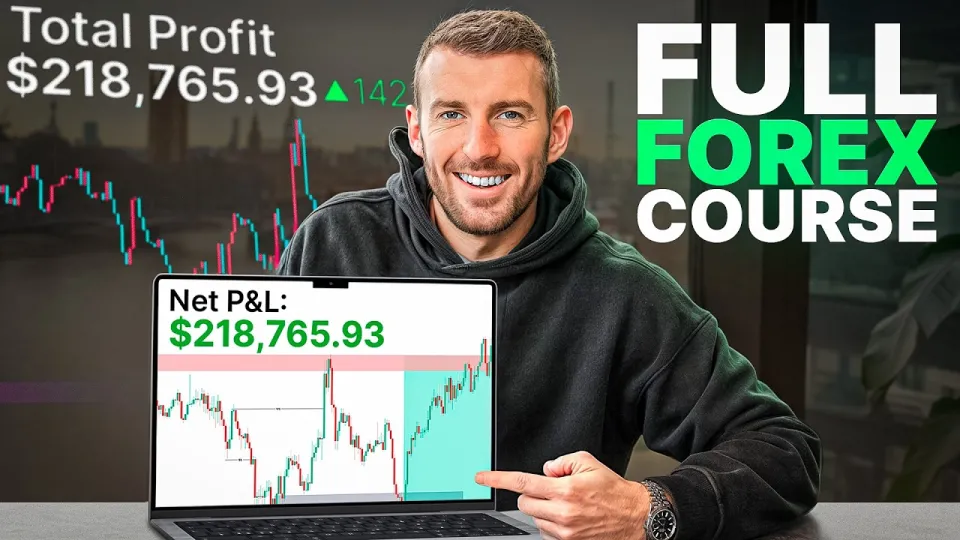
Video: Beginners Guide To Forex Trading In 2026 (+3 hours)
Need articles like this for your video? They help promote it on YouTube and Google — order them in the Telegram bot @sat_sit_bot. Articles with your video embedded are written and posted by the bot itself — on popular topical sites (no ads). Free trial — 50 articles.
· based on the channel Matt Donlevey - Photon Trading
Key takeaways
- Forex is an over-the-counter market where currencies are quoted in pairs, and retail traders usually access it through leveraged brokers rather than a single exchange.
- Price moves because of order flow and liquidity, not because a chart shape looks like a triangle or a head and shoulders.
- Every trade carries two costs before it starts: the spread between bid and ask, plus commissions and swap on positions held overnight.
- Matt Donlevey's free Photon Trading course and cheatsheets are available at https://www.photontradingfx.com/free-training?el=beginnersguide&htrafficsource=YT
- A written trade plan, a backtest log and a journal matter more for survival than any single entry pattern.
Forex trading is the business of buying and selling currency pairs to profit from changes in their exchange rates, and beginners should learn it in a fixed order: understand what the market is, how orders actually move price, then build one strategy, size risk, and record every trade. The full beginner walkthrough from the Matt Donlevey - Photon Trading channel covers exactly that path, and the free Photon Trading course plus cheatsheets that accompanies it is available at the Photon Trading free training page.
What forex trading actually is and who is on the other side
Forex is a decentralized over-the-counter market where currencies are always quoted in pairs, so every position is simultaneously long one currency and short another. There is no single central exchange: banks, funds, brokers and liquidity providers quote prices to each other, and retail traders reach that flow through a broker that routes orders onward. The most traded pair is EUR/USD, followed by USD/JPY and GBP/USD, and the bulk of volume happens during the London and New York sessions when the two largest financial centres overlap.
That structure explains two things beginners usually miss. First, your broker is a counterparty or an intermediary, not a charity, which is why execution quality and costs deserve as much attention as chart reading. Second, the retail trader is a very small participant in a very large pool, so the realistic goal is not to predict the market but to trade a repeatable edge with controlled risk. The video's framing is blunt about this: geometric shapes on a chart do not explain why price moves, and a strategy built on shapes alone has no underlying logic.
How price really moves: microstructure, order book and order flow
Price changes because aggressive orders consume resting liquidity, and understanding that mechanism is the foundation of every later decision. A quote has two sides — the bid, where buyers are willing to buy, and the ask, where sellers are willing to sell — and the gap between them is the spread, which is a cost paid on entry. A tight spread on EUR/USD in a liquid session can be a fraction of a pip, while exotic pairs and quiet hours can widen it several times over.
The order book is the visible queue of resting limit orders at each price level, and auction market theory describes what happens when that queue is thin: a relatively small market order can travel through several levels and move price quickly. Order flow is the record of who is being aggressive, buyers or sellers, and where their orders get absorbed. When resting liquidity is swept and price then reverses, that tells you the move was about accessing liquidity rather than about genuine directional conviction. This is why two identical candle patterns can produce opposite outcomes in different contexts.
The Photon strategy toolkit: structure, premium and discount, supply and demand
The Photon approach builds a systematic strategy on those dynamics rather than on chart geometry, and it starts with market structure. Structure means the sequence of swing highs and swing lows that defines whether the market is trending up, trending down, or ranging, and the framework separates three structural states so a trader knows which playbook applies. Multi-timeframe analysis then aligns that structure: a higher timeframe sets the bias, and a lower timeframe is used only for timing an entry inside that bias.
Premium and discount pricing is the second pillar. If a range is divided in half, the upper half is premium and the lower half is discount, and the logic is to buy in discount and sell in premium rather than chasing price at the extremes. Supply and demand zones mark areas where aggressive orders previously overwhelmed resting liquidity, so price is expected to react when it returns. Liquidity concepts complete the picture: equal highs, equal lows and obvious swing points attract resting orders, and those pools are what large participants need in order to fill size. Putting it all together means waiting for price to reach a high-probability zone in the correct structural context, then entering on confirmation rather than on hope.
Money management and the three mistakes that end most accounts
Risk control is the part of trading that decides whether a strategy ever gets a chance to work, and the practical rule is to risk a small fixed percentage of the account per trade. If you risk 1% per position, a run of ten losses costs roughly 10% of the account and remains recoverable; if you risk 10% per position, the same run is close to fatal. Position size is calculated from that risk number and the distance to your stop, not chosen by feel, and leverage should be treated as a tool for capital efficiency rather than as a way to increase exposure.
The three common mistakes the course highlights are worth stating plainly. First, trading without a written plan, which makes results impossible to evaluate. Second, risking too much on a single idea, which turns a normal losing streak into an account-ending event. Third, skipping the journal, which means the same errors repeat for months without being noticed. All of these are behavioural, not analytical, which is why the psychology section comes after the strategy rather than before it: you cannot manage the emotions of a system you have not yet defined.
Execution, costs and choosing a broker
Execution quality and trading costs determine how much of your edge survives contact with reality, so both belong in the plan before the first live trade. Spread, commission and swap on positions held overnight are the three recurring costs, and on a short-term strategy they can easily exceed the average profit per trade if you ignore them. Choosing a broker means checking regulation, order routing, average spreads during your trading session, slippage behaviour around news, and whether the platform supports the order types your strategy requires.
Executing a trade is a checklist, not an impulse: confirm the higher-timeframe bias, confirm price is in the correct premium or discount zone, define entry, stop and target before clicking, then log the trade. Backtesting comes before all of this. A strategy should be run over a meaningful sample of historical data with the exact rules written down, and the results recorded trade by trade, because a plan that has never been tested is a hypothesis rather than a system.
Questions beginners keep asking
A recurring doubt is speed and density: a three-hour course packs a lot of material, and non-native speakers in particular report that the pace is demanding. The practical fix is to watch one topic at a time, take notes, and immediately backtest the concept on a chart before moving on. Another common question is whether such material is genuinely free, given that comparable courses are sold for four figures; the free training link in the description is the entry point, with mentorship offered separately.
Experienced traders also raise a fair point: much of the value sits in the explanation of how the market works, not in the entry patterns, and people who have studied for years still report learning something in the first hour. The honest expectation to set is that the video is a map, not a shortcut. Results come from repetition — backtesting, journalling, and reviewing losing trades — and no video, however long, replaces that work.
Useful links
- Free Photon Trading course and cheatsheets: https://www.photontradingfx.com/free-training?el=beginnersguide&htrafficsource=YT
- Photon Trading mentorship programme: https://www.photontradingfx.com?el=beginnersguide&htrafficsource=yt
- Free Telegram channel with analysis, trade recaps and tips: https://t.me/photontrading
- Instagram, Photon Trading: https://www.instagram.com/photontrading/
Final thoughts
Learning forex in a fixed sequence — market mechanics, order flow, one strategy, risk, journal — is slower at the start and far cheaper later than jumping between entry patterns. The Matt Donlevey - Photon Trading breakdown is useful precisely because it puts microstructure, liquidity and money management in the same framework instead of selling a shortcut, and the free course behind it is a sensible place to start. Pick one concept, backtest it, log the results, and only then add the next layer. If you want the structured version with the cheatsheets, begin with the free Photon Trading training.
Source: Beginners Guide To Forex Trading In 2026 (+3 hours) · Markdown version
Questions & answers
Do I need a large account to start trading forex?
No. Because currencies are traded in lots and most brokers offer micro and nano lots, a small account can hold a properly sized position. What matters is that risk per trade stays a small fixed percentage of the balance, so a normal losing streak does not end the account.
Is technical analysis useless, as the video suggests?
The critique targets chart shapes used without context, not price reading in general. Structure, supply and demand zones and liquidity levels are technical tools, but they are interpreted through order flow and auction logic rather than treated as magic patterns.
What should I learn first: strategy or trading psychology?
Strategy comes first. You cannot manage the emotions of a system you have not defined or tested, so build the rules, backtest them, and only then work on discipline and consistency under live conditions.
How much does the Photon Trading material cost?
The beginner course and cheatsheets are offered free through the training link in the video description. The mentorship programme that promises funded trading is a separate paid product, so treat the free material as the starting point and evaluate the rest on its own merits.